China travel guide
Emergency Numbers in China for Travelers: What to Call and What to Do
Save China's police, ambulance, fire, traffic, government-service, and immigration numbers, plus clear steps for medical emergencies and a lost passport.
Planning
Save this page offline before your trip. Language support and local procedures can vary by city.
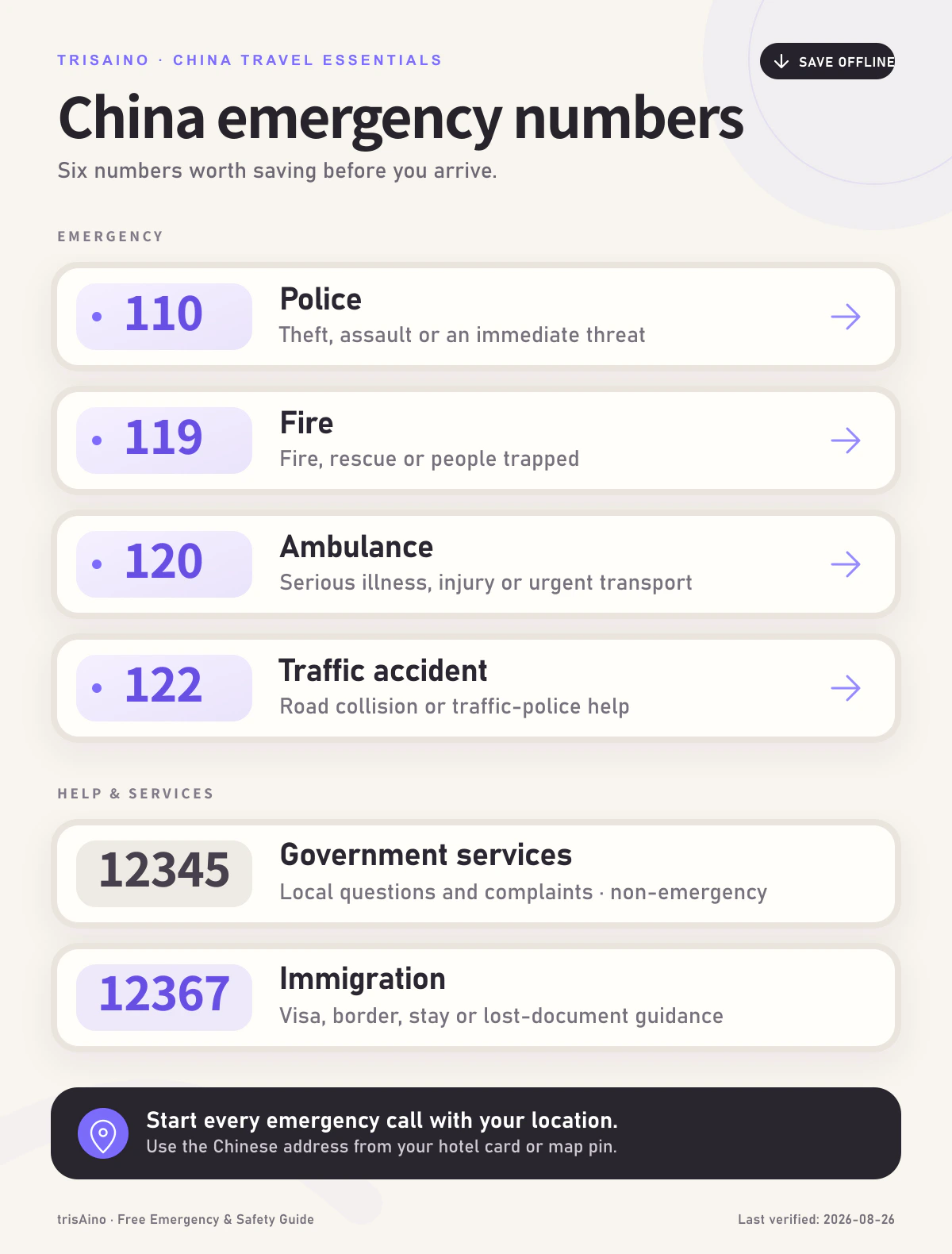
China emergency numbers at a glance
| Situation | Number | Use it for |
|---|---|---|
| Police | 110 | Theft, robbery, assault, an immediate threat, or urgent police help |
| Fire and rescue | 119 | Fire, explosion, people trapped, building collapse, or other fire-rescue emergencies |
| Ambulance / medical emergency | 120 | Serious injury, loss of consciousness, severe illness, or urgent medical transport |
| Traffic accident | 122 | Road collisions and traffic-police assistance |
| Government services | 12345 | Non-emergency local-government questions, complaints, and public-service help |
| Immigration services | 12367 | Visa, entry, border, stay, residence, and immigration questions |
The three numbers every traveler should memorize are 110, 119, and 120. China's official guidance identifies them as the core police, fire, and medical-emergency lines. The NIA's 12367 service operates around the clock and provides direct English voice support for immigration questions.
What should I say when calling an emergency number in China?
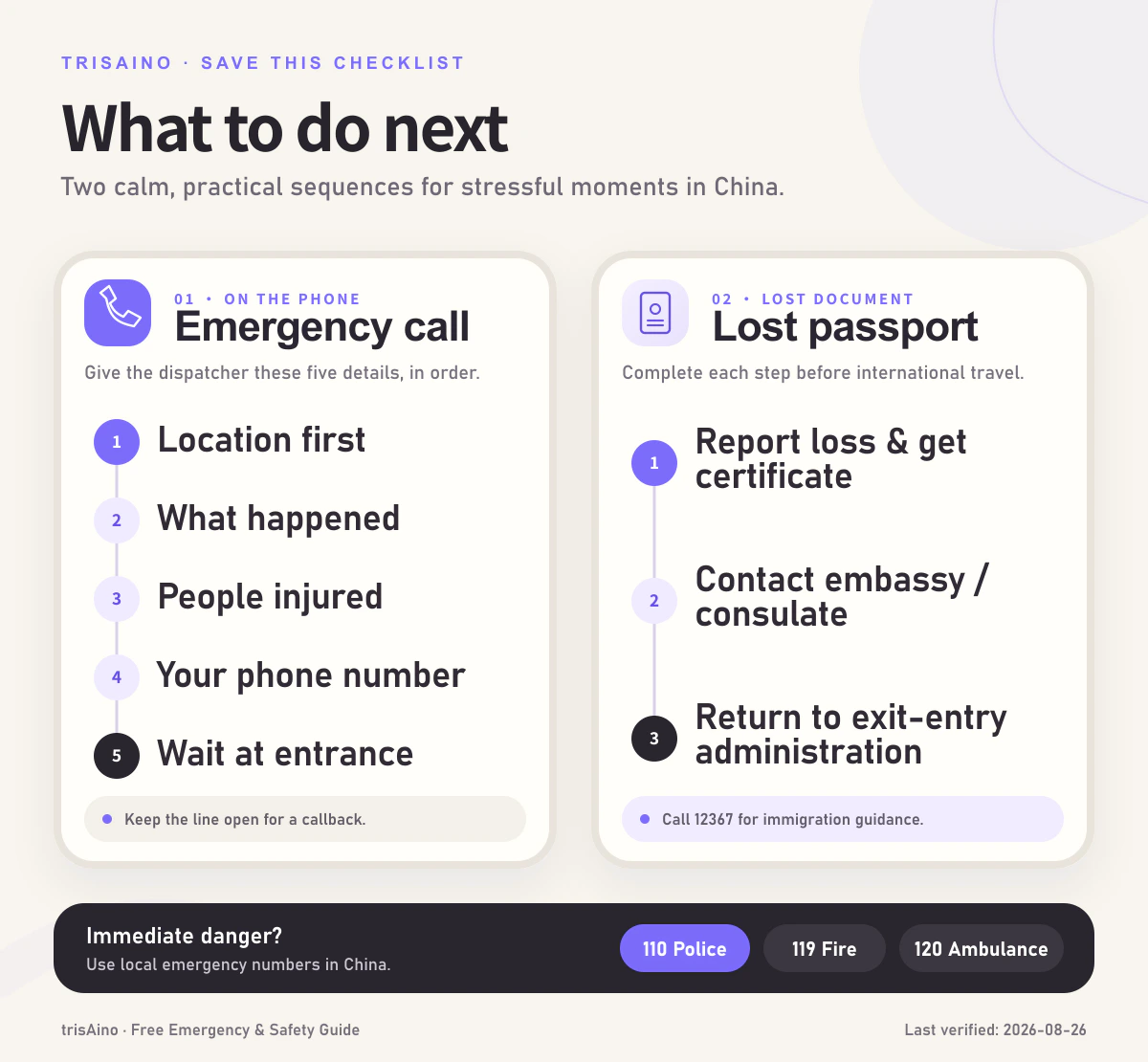
Start with the location. A responder cannot help quickly if they do not know where you are.
Give the information in this order:
- Your exact location. Read the Chinese address from your hotel card, map pin, building entrance, or screenshot.
- What happened. Say police, fire, traffic accident, unconscious person, injury, or another short description.
- How many people need help. Mention whether anyone is trapped, bleeding, unconscious, or unable to move.
- Your phone number and name. Stay available for a callback.
- A visible meeting point. If possible, ask someone to wait at the hotel entrance, compound gate, or nearest intersection to guide responders.
Official Shanghai guidance gives the same practical sequence for 119 and 120: provide a detailed location, explain the emergency, share contact information, and help the responding team find the entrance.
Useful Chinese phrases to show on your phone
You do not need perfect pronunciation. Showing the sentence on screen is often faster.
| English | Chinese | Pinyin |
|---|---|---|
| Help! | 救命! | Jiùmìng! |
| Please call the police | 请报警 | Qǐng bàojǐng |
| Please call an ambulance | 请叫救护车 | Qǐng jiào jiùhùchē |
| I need a doctor | 我需要医生 | Wǒ xūyào yīshēng |
| My location is... | 我的位置是…… | Wǒ de wèizhì shì... |
| I am allergic to... | 我对……过敏 | Wǒ duì... guòmǐn |
| I am lost | 我迷路了 | Wǒ mílù le |
| My passport is lost | 我的护照丢了 | Wǒ de hùzhào diū le |
Can I call 110, 119, or 120 in English?
English support is available in some major cities, but it is not safe to assume the same language coverage everywhere.
Shanghai's official international-service portal states that its 110 line supports eight foreign languages and that 119 and 120 are available in English. Other cities may connect an English-speaking operator, use an interpreter, or ask you to wait while support is found.
Prepare for the call anyway:
- Save the Chinese address of every hotel.
- Screenshot your live map location.
- Ask a hotel, restaurant, station, or nearby person to help call if communication is failing.
- Keep “我不会说中文” (Wǒ bú huì shuō Zhōngwén, “I do not speak Chinese”) ready.
For immigration matters, 12367 is the more predictable multilingual option. The NIA says the hotline provides immediate English voice service 24 hours a day, with additional interpreted language options.
What should I do in a medical emergency in China?
Call 120 when the situation is serious or the patient cannot safely reach a hospital without medical transport.
While waiting:
- Send someone to the entrance or nearest intersection.
- Keep the patient's passport, medication list, allergy information, insurance certificate, and phone ready.
- Do not give food, drink, or medication to an unconscious person unless a qualified professional instructs you.
- If the situation changes, call 120 again and update the dispatcher.
In a life-threatening situation, prioritize the nearest appropriate emergency department. Major cities also have public hospitals with international medical departments and private international hospitals with stronger English support. Private and international services can be expensive, so carry travel insurance that covers medical treatment and evacuation.
Do not assume the ambulance or hospital visit is free. Be ready to show identification and arrange payment or an insurance guarantee. Beijing's official medical guide notes that international patients can use bank cards and that private medical costs can be comparable to North America or Europe.
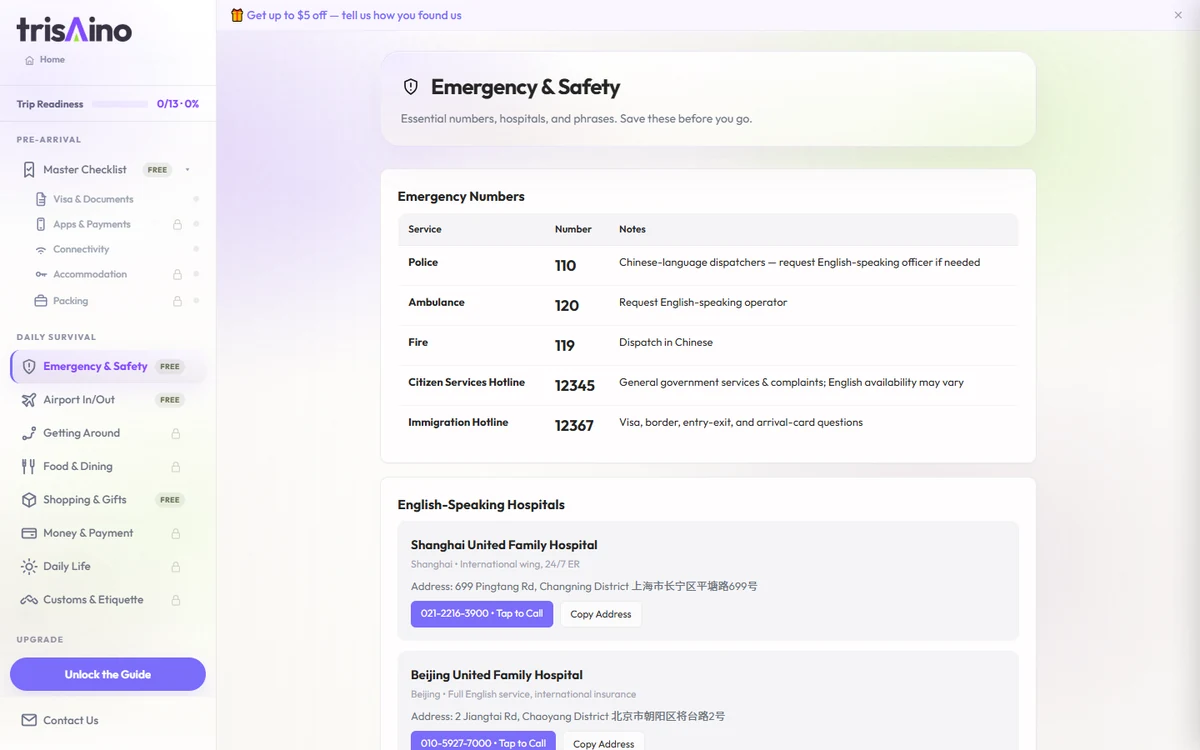
The free Emergency & Safety Guide includes a city-based list of English-speaking hospitals and tap-to-call details. Recheck the hospital directly before relying on a saved address or phone number.
What should I do if my passport is lost or stolen in China?
Use this sequence:
- Report the loss. Contact the local police or the local public-security exit-entry administration and obtain a passport-loss certificate or police report.
- Contact your embassy or consulate. Use the certificate to apply for a replacement passport or emergency travel document.
- Return to the exit-entry administration. After receiving the replacement document, apply for the required visa reissuance, stay permit, or other exit formality before traveling internationally.
The NIA specifically advises travelers to obtain a passport-loss certificate, contact their embassy or consulate, and then complete the replacement immigration formality with the local exit-entry authority.
Keep a digital copy of your passport information page, visa, entry stamp, and travel insurance somewhere separate from the physical passport. A copy does not replace the original, but it makes the reporting and replacement process easier.
What should I do after theft or a lost phone?
If there is an immediate threat or theft in progress, call 110. Once you are somewhere safe:
- Ask your hotel or another trusted local contact to help explain the location and incident.
- Obtain a police report if your insurer, bank, or embassy may require one.
- Freeze stolen bank cards and contact the card issuer.
- Use another device to lock or erase the phone where possible.
- Change passwords for email, mobile payment, and any account that can reset other accounts.
- Contact your mobile provider to suspend the SIM or eSIM.
- Preserve receipts, screenshots, device serial numbers, and tracking information.
Do not chase a suspected thief or travel alone to an unfamiliar location shown by a device tracker. Give the information to the police.
When should I use 12345 or 12367?
Call 12345 for non-emergency local-government help
12345 is the local government-service hotline. It is useful for public-service questions, complaints, and problems that need a city department but are not emergencies. Language coverage varies by city. Shanghai, for example, provides multilingual service on its 12345 line.
Do not use 12345 instead of 110, 119, or 120 when life, health, or immediate safety is at risk.
Call 12367 for immigration and border questions
Use 12367 for:
- Visa and visa-free entry questions.
- Border and arrival procedures.
- Stay or residence matters.
- Accommodation-registration questions.
- Lost-passport immigration steps.
- Questions about the NIA online service platform.
From outside mainland China, the NIA describes the service as +86-12367. The hotline and NIA 12367 digital channels provide bilingual Chinese and English support.
Build a five-minute emergency card before departure
Save one note on your phone containing:
- 110 police, 119 fire, 120 ambulance, and 122 traffic.
- Hotel name, full Chinese address, and front-desk phone number.
- Travel-insurance policy number and emergency-assistance line.
- Embassy or consulate contact.
- Passport number and a link to the secure backup copy.
- Allergies, medical conditions, blood type if known, and essential medication.
- One emergency contact at home.
Make the note available offline. Share it with anyone traveling with you.
Pair this emergency card with the complete China pre-travel checklist so your entry documents, payment backup, mobile data, hotel address, and carry-on essentials are ready before departure.
Plan the trip around the details that matter
Emergency information is most useful when it is saved before you need it. Keep the free trisAino Emergency & Safety Guide with your trip documents. Then use the free trisAino AI Planner to build a realistic route with sensible days, city order, and travel time.
How this safety guide is verified
The trisAino editorial team checks the core emergency numbers against Chinese central and city-government guidance, verifies 12367 and lost-passport procedures against the National Immigration Administration, and links the official sources below. Language support, hospital availability, and local procedures can differ by city, so those details are framed as variable and should be rechecked locally.
FAQ
What are the main emergency numbers in China?
Call 110 for police, 119 for fire, 120 for an ambulance or medical emergency, and 122 for a road traffic accident.
Does 911 or 112 work in China?
Do not depend on them. Save and use China's local numbers: 110 for police, 119 for fire, and 120 for an ambulance or medical emergency.
Is 120 ambulance service free in China?
Do not assume it is free. Ambulance transport and hospital treatment may generate charges, and a hospital may request payment or an insurance guarantee. Carry travel insurance and a usable payment backup.
Can tourists call 110 in English?
Some major cities provide English or multilingual support, but nationwide availability varies. Give the address first, show Chinese text where possible, and ask a nearby staff member to help if communication fails.
What number should I call about a China visa or lost passport?
Call the National Immigration Administration on 12367 for immigration guidance. For a lost passport, also report the loss locally, contact your embassy or consulate, and complete the replacement immigration formalities.
Should I go to an international hospital or the nearest hospital?
For a life-threatening emergency, prioritize the nearest appropriate emergency department or follow the 120 dispatcher's advice. For non-critical care, an international department or private international hospital may provide easier English service, but costs can be higher.
Sources
- State Council and Ministry of Commerce: How to get help in emergencies
- Shanghai Government: What to do in an emergency
- Beijing Government: Emergency numbers
- National Immigration Administration: China Immigration Service Hotline 12367
- National Immigration Administration: Lost passport guidance
- Beijing Government: Medical guide for foreigners
- Shanghai Government: 12345 public-service hotline
This article provides general travel preparation, not medical, legal, or consular advice. Follow instructions from emergency responders, medical professionals, immigration authorities, and your embassy or consulate.
Turn the answer into a safer, workable trip
Keep practical emergency information in the free Guide, then use the planner to build a realistic day-by-day route.